Long-distance travel sounds relaxing until you have been sitting in the same position for several hours, your legs feel stiff, the seat no longer feels comfortable, and a large part of the journey is still left.
Whether you are crossing countries by train or spending eight hours on a plane, the biggest challenge is often not the distance itself. It is staying reasonably comfortable while sitting in a limited space where you cannot move whenever you want.
That is why packing for a long journey should involve more than headphones, snacks, and a phone charger. Simple comfort items such as a travel seat cushion, supportive clothing, water, and a few practical accessories can make extended sitting much easier.
This guide explains what is genuinely worth packing, how an airplane seat cushion or train travel cushion can fit into your travel setup, and what you can do during the journey to stay more comfortable without carrying half your home in your luggage.
Why Long Flights and Train Journeys Become Uncomfortable
Most people can sit comfortably for a short journey. The problem begins when that sitting position continues for several hours.
Airplane and train seats are designed to accommodate large numbers of passengers with different body shapes and sizes. They cannot be perfectly adjusted for every individual.
On an aircraft, your space may also be limited by the passenger in front of you, the armrests, your hand luggage, and the narrow aisle.
Train travel usually provides more freedom to stand and move, but the seats can still become uncomfortable during a four-, six-, or eight-hour journey.
Over time, pressure remains concentrated around the areas contacting the seat. You may also begin sliding forward, crossing your legs repeatedly, leaning to one side, or constantly repositioning yourself.
A good travel setup cannot remove every inconvenience of long-distance transport, but it can make the journey easier to manage.
Is a Travel Seat Cushion Worth Packing?
A travel seat cushion can be useful for people who regularly find airplane, train, coach, or waiting-area seats uncomfortable.
The main advantage is consistency.
Instead of relying entirely on whatever seat is provided, you carry your own supportive layer with you.
A good cushion can help distribute pressure across the sitting surface and provide additional support when the seat beneath you is firm, flat, or worn.
Portability matters, though.
A large household cushion may be comfortable but becomes annoying once you have to carry it through an airport, security checkpoint, railway station, and several boarding areas.
For travelling, a cushion should balance comfort with size and weight.
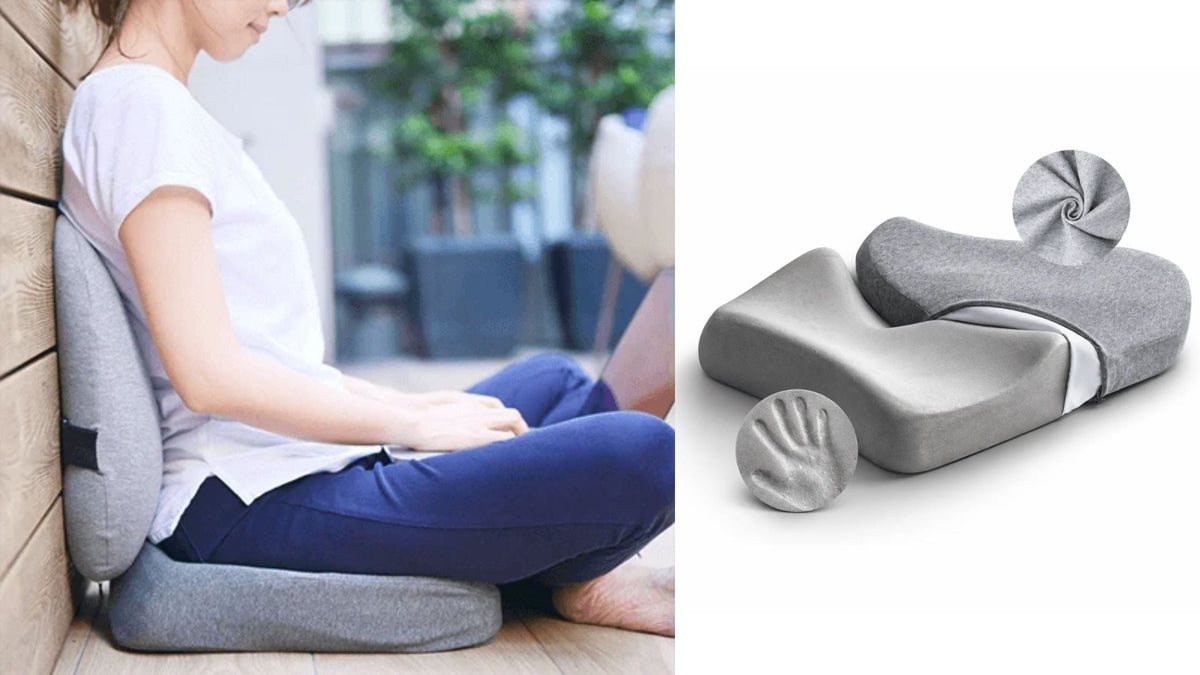
At Clessio, the Orthopedic Comfort Seat Cushion is designed as a portable seating support option that can be used across different environments, including travel, office chairs, home seating, and other situations involving prolonged sitting.
What to Look for in an Airplane Seat Cushion
An airplane seat cushion needs to work differently from something you permanently leave on an office chair.
Aircraft seats have limited width, and adding too much height can affect your seating position.
Look for a cushion that fits within the seat rather than hanging over the edges.
A contoured design can help distribute pressure, while supportive foam should retain its shape throughout the flight rather than flattening after the first hour.
A non-slip base can also be useful because you may shift position regularly during a flight.
Most importantly, check how the cushion changes your height.
If it raises you so much that your head position becomes uncomfortable against the headrest, or your legs no longer sit naturally beneath the tray table, it may be too thick for that particular seat.
The best flight seat cushion should improve the seat without creating another problem.
Cushion for Long Flights: Softness Is Not Everything
It is tempting to assume that the softest cushion will automatically be the most comfortable.
For long sitting periods, that is not always the case.
Very soft foam can compress under your body and eventually leave you feeling as though you are sitting directly on the seat again.
A cushion for long flights generally needs enough density to continue providing support several hours into the journey.
Memory foam is commonly used because it responds to pressure while gradually returning to its original shape.
Contoured cushions may also reduce direct pressure around specific contact areas.
When choosing one, think about the whole journey, not just the first ten minutes.
What Makes a Good Train Travel Cushion?
A train travel cushion gives you slightly more flexibility because train seating often provides more space than an aircraft cabin.
You may also be able to stand, walk between carriages, or reposition yourself more easily.
However, long train journeys can involve just as much sitting.
For railway travel, portability is still important, especially if your trip includes changing platforms or connecting services.
A cushion with a removable washable cover is particularly useful for frequent travellers because it may be placed on multiple public seats throughout a journey.
If you regularly work from your laptop while travelling by train, think about seat height as well.
Adding a thick cushion can change your relationship with the table. You should still be able to type without lifting your shoulders excessively or leaning forward.
A Travel Cushion Should Be Easy to Carry
A travel accessory is only useful if you are willing to bring it with you.
Before buying a cushion specifically for travel, consider how it will fit into your luggage routine.
Can it be carried alongside your cabin bag?
Is it light enough for a long walk through an airport?
Will it fit into your suitcase when you do not need it?
Can you carry it between railway platforms without it becoming inconvenient?
Some travellers prefer cushions that compress slightly for packing, while others prioritise firmer support even if that means carrying the cushion separately.
There is no single correct choice. Your trip length, luggage allowance, and personal comfort priorities all matter.
What Else Should You Pack for a Long Journey?
A seat cushion can improve the surface beneath you, but overall travel comfort comes from several small things working together.
A Light Layer of Clothing
Cabin and train temperatures can change quickly.
A lightweight jumper, cardigan, or similar layer is easier to manage than being too cold for several hours.
Choose comfortable clothing that does not feel restrictive while sitting.
Water
Long journeys can make it easy to forget to drink regularly, especially when you are trying to avoid frequent trips to the bathroom.
Keeping water available allows you to drink gradually throughout the journey.
For flights, remember that airport security restrictions may affect how much liquid you can carry through the checkpoint, so filling a reusable bottle after security may be more practical where facilities allow.
Neck Support
A seat cushion supports the seating surface, while a travel neck pillow serves a different purpose.
If you plan to sleep during the journey, neck support may help you avoid repeatedly dropping your head to one side.
Choose one that suits your preferred sleeping position rather than simply buying the largest pillow available.
Eye Mask
An eye mask is small, light, and useful when cabin or carriage lighting makes resting difficult.
It can be particularly useful on overnight journeys where other passengers may still be using screens or reading lights.
Earplugs or Noise-Cancelling Headphones
Noise can become tiring during a long trip.
Aircraft engines, announcements, conversations, children, railway noise, and station activity can make resting difficult.
Earplugs require almost no luggage space, while noise-cancelling headphones can make a noticeable difference if you travel frequently.
Do Not Let Your Backpack Become a Footrest Problem
One common mistake is filling the space under the seat in front of you with a large bag.
This reduces the amount of room available for your feet and can keep your legs in an awkward position for hours.
If possible, arrange your luggage so you still have some freedom to reposition your feet.
On a flight, you may be able to move your personal item after take-off once cabin rules allow it.
On a train, use luggage racks when practical instead of surrounding your legs with bags.
Comfort often comes from having room to change position rather than finding one supposedly perfect sitting posture.
How to Sit More Comfortably During a Long Flight
Once you are seated, use the full seat rather than spending the entire journey perched on the front edge.
Allow the backrest to support you when possible.
Keep your feet supported rather than pulling them underneath the seat for long periods.
Try not to spend hours leaning toward a laptop or phone positioned in your lap.
If you are watching a film on a personal device, position the screen as comfortably as the space allows instead of continuously bending your neck toward it.
Your position will naturally change during the journey, and that is a good thing.
Comfort is not about holding one rigid posture from take-off to landing.
Movement Matters More Than Any Travel Accessory
Even an excellent flight seat cushion cannot remove the need to move.
On long flights, stand and walk when it is safe and permitted to do so.
A short walk to the bathroom or along the aisle gives you an opportunity to change position after sitting for an extended period.
You can also make small movements while seated, such as changing foot position and gently moving your ankles.
Train passengers generally have more freedom.
If the journey is several hours long, standing occasionally or walking through the carriage can break up prolonged sitting.
Your seat cushion should support your sitting time. It should not encourage you to remain completely still for the entire journey.
Window Seat or Aisle Seat for Long Travel?
Your seat choice can influence comfort almost as much as what you pack.
A window seat allows you to lean toward the side of the cabin and avoids being disturbed when other passengers want to move.
The disadvantage is that you may be less willing to stand up because you need to ask other passengers to move.
An aisle seat makes it easier to stand and walk during the journey.
For travellers who know they become uncomfortable after sitting for several hours, easier access to the aisle may be more valuable than the window view.
On trains, the same principle applies, although getting out of your seat is usually much easier.
What About Lower-Back Support?
A travel seat cushion primarily changes the surface you are sitting on.
It does not necessarily provide support higher up the back.
Some transport seats already have shaped backrests, while others feel very flat.
A small lumbar support or rolled item of clothing may help fill an uncomfortable gap between your lower back and the seat.
Avoid building such a large support behind yourself that you are pushed toward the edge of the seat.
The goal is subtle support, not forcing your body into an exaggerated position.
Long-Haul Travel With a Laptop
Working during a flight or train journey introduces another challenge.
Laptop screens sit low when the device is placed on a tray table.
This often results in the head and upper body leaning forward.
On a train with a larger table, you may have more freedom to reposition the laptop.
On an aircraft, there is less room to improve the setup, so avoid treating a temporary tray table as though it were a full office workstation.
If you need to work, divide the task into shorter periods.
Complete focused work, put the laptop away, change position, and return to it later if necessary.
Trying to maintain a laptop-working position for the entire flight can become uncomfortable regardless of how good the seat cushion is.
Common Travel Comfort Mistakes
One mistake is packing too many accessories.
If your neck pillow, seat cushion, blanket, laptop case, headphones, water bottle, and other comfort products become a second suitcase, the extra luggage may create more inconvenience than comfort.
Choose the items that address problems you actually experience.
Another mistake is assuming softness automatically means support.
A very soft cushion may feel luxurious during boarding but provide little benefit once it has been compressed for several hours.
Travellers also sometimes forget that adding a cushion changes seat height.
Always pay attention to whether the new position feels natural.
Finally, do not remain completely still just because your seat feels more comfortable.
Movement remains one of the most important parts of a long journey.
Long Flight Packing Checklist
For most long-distance trips, a simple comfort kit is enough:
-
Supportive travel seat cushion
-
Neck pillow if you plan to sleep
-
Light clothing layer
-
Water bottle where travel rules permit
-
Noise-cancelling headphones or earplugs
-
Eye mask for overnight travel
-
Comfortable clothing
-
Charging cable or power bank where permitted
-
Essential medication kept accessible
-
Small personal hygiene items
-
Entertainment or downloaded content
-
Travel documents stored somewhere easy to reach
You do not need every travel gadget available online. Pack around the length of your journey and the specific things that normally make you uncomfortable.
Is a Travel Seat Cushion Useful After the Journey?
One advantage of choosing a versatile cushion is that it does not become useless once your holiday or business trip is over.
A portable cushion can also be used on an office chair, dining chair, home seating, car seat, or temporary workspace.
That makes more sense for many travellers than buying a highly specialised accessory that only leaves the cupboard twice a year.
If portability is important to you, consider how easily the cushion can move between different environments before buying.
When a Travel Cushion Is Not the Answer
Travel accessories can improve everyday comfort, but they are not medical treatment.
A seat cushion cannot diagnose or treat an underlying condition.
If you experience persistent pain, significant swelling, numbness, weakness, unusual shortness of breath, or other concerning symptoms during or after travel, seek appropriate medical advice rather than assuming the seat itself is responsible.
People with specific medical conditions or circulation concerns may also receive individual travel advice from their healthcare professional.
For everyone else, the goal of a cushion and other comfort accessories is simply to make prolonged sitting more manageable.
Frequently Asked Questions
Is a travel seat cushion allowed on airplanes?
In general, passengers can travel with ordinary personal comfort items, but airline baggage policies and cabin requirements vary. Your cushion should not obstruct the aisle, interfere with your seatbelt, or prevent you from sitting safely. Check your airline's current rules if you are travelling with an unusually large cushion.
What type of airplane seat cushion is best for long flights?
A supportive, reasonably compact airplane seat cushion is usually more practical than a very thick cushion. Look for a design that fits within the aircraft seat, retains its shape, and does not raise your seating position excessively.
Is memory foam good for a flight seat cushion?
Memory foam is commonly used in seat cushions because it responds to pressure and returns toward its original shape after use. For long journeys, density and overall design matter as much as the material itself.
Can I use a seat cushion on a train?
Yes. A train travel cushion can be useful on long railway journeys, especially if you find firm or flat seating uncomfortable. Make sure it fits securely within the seat and does not place you too high relative to a table if you plan to work.
Is a cushion for long flights worth carrying?
If you frequently become uncomfortable after several hours of sitting, a cushion for long flights may be worth the extra item. Travellers who rarely have seating discomfort may prefer to keep their luggage lighter.
Can I use the same travel seat cushion on a plane and train?
Yes. A portable, appropriately sized cushion can usually be moved between airplane seats, train seats, cars, office chairs, and other seating environments.
Should I use a seat cushion for the entire flight?
You can use one while seated if it remains comfortable and does not interfere with safe seating or your seatbelt. Regardless of the cushion, change position and move periodically when it is safe and practical to do so.
Final Thoughts
A comfortable long journey is rarely the result of one perfect travel accessory.
It comes from making several sensible choices: wearing comfortable clothing, keeping essential items within reach, giving yourself enough room to move, choosing a suitable seat when possible, and avoiding spending the entire journey completely still.
A well-designed travel seat cushion can be a useful part of that setup, particularly if airplane or train seats usually become uncomfortable for you after a few hours. The best option is supportive enough for prolonged sitting, compact enough to travel with, and versatile enough to use beyond a single journey.
At Clessio, we focus on practical comfort solutions that can move with everyday life. Whether you are taking a long-haul flight, crossing the country by train, commuting, working at a desk, or sitting at home, the aim is simple: make extended sitting more comfortable without overcomplicating your routine.
Pack what solves a real problem, leave behind what does not, and remember that even the best airplane seat cushion works best when it is combined with regular movement and a sensible sitting position.
A long journey may be unavoidable. Being unnecessarily uncomfortable for every hour of it does not have to be.


Leave a comment
This site is protected by hCaptcha and the hCaptcha Privacy Policy and Terms of Service apply.